Research Projects
War, the End of Empire, and the Expansion Women’s Political Citizenship
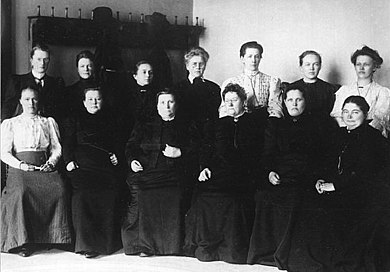
13 of the 19 female members of the Finnish parliament — the first female members of a national parliament in the world – elected in 1907. Photo credit: Ministry for Foreign Affairs of Finland.
I am currently directing a project funded by the National Science Foundation on War, the End of Empire, and the Expansion of Women’s Political Citizenship. This project builds on my 2015 book, Women and Power in Postconflict Africa. I show through historical process tracing how major conflict and the end of empire is tied to the expansion of women’s political citizenship in the 20th century, looking at the cases of Finland, Türkiye, Tunisia, Tanzania, Mozambique, and the counterfactual case of Switzerland. I have benefited from the research assistance of Pihla Pekonen (Finland), Sawsene Nejjar (Tunisia), Eva Granwehr (Switzerland), Hiba Irmak and Atacan Atakan (Türkiye), Farida Silla (Tanzania), Joana Ramos (Mozambique), Carlos Fernandes (Mozambique), and Monica Komer, and Jérémie Langlois (United States).
Women’s Rights and the New World Order
The United States has closed down the US Agency of International Development and is withdrawing from multilateral agencies, while funding for women’s rights from both the United Nations and Europe is declining. These shifts are reshaping the liberal, rights-based norms that have long influenced women’s rights mobilization globally since the end of World War II. However, there is limited understanding of how these changes in international funding are affecting the capacity, priorities, and strategies of civil society and women’s rights organizations in aid-dependent contexts such as Tanzania. This study asks whether declining donor support constrains activism or whether it creates opportunities for new, more locally grounded forms of mobilization. It also examines whether it forced the government to seek new mechanisms to fill the gap left by these cuts. This study seeks to address this question by examining how women’s rights organizations and the Tanzanian government are adapting to shifting funding landscapes and whether these changes are creating opportunities for alternative solutions.